
As electricity supply in Nigeria remains unreliable, more homeowners are turning to solar and inverter systems for stable power. However, one of the most common mistakes people make before installing an inverter or solar system is not properly calculating their home’s energy load. This often leads to undersized systems, frequent inverter beeping, battery damage, or wasted money on oversized setups.
The good news is that you can calculate your home’s energy load yourself-without being an electrical engineer. In this guide, we’ll break it down in a simple, practical way that works for Nigerian homes, apartments, and estates. We’ll also explain why professional installers like KSOP Global Limited always start with load calculation before recommending any system.
What Is Energy Load?
Your energy load is the total amount of electrical power (watts) your appliances consume at any given time. It answers three critical questions:
- How big should your inverter be?
- How many batteries do you need?
- How many solar panels are required?
Without accurate load calculation, your system may fail under pressure-especially during peak usage times.
Why Calculating Your Home’s Energy Load Is Important
Many Nigerian homes experience issues because load estimation is done by guesswork. Proper calculation helps you:
- Avoid inverter overload and constant beeping
- Prevent battery over-discharge and early failure
- Save money by buying the right system size
- Enjoy uninterrupted power supply
- Plan future expansion easily
This is why professional solar companies like KSOP Global Limited insist on load audits before installation.
Tools You Need to Calculate Energy Load
You don’t need anything complicated. Just:
- Pen and paper (or phone notes)
- List of appliances in your home
- Appliance power ratings (in watts)
- Basic calculator
Power ratings are usually written on the appliance label or in the manual.
Step 1: List All Electrical Appliances in Your Home
Start by listing only the appliances you want to power with your inverter or solar system, not necessarily everything in the house.
Typical Nigerian household appliances include:
- LED bulbs
- Ceiling or standing fans
- Television
- Decoder
- Refrigerator
- Laptop
- Desktop computer
- Wi-Fi router
- Phone chargers
- Washing machine
- Water pump
- Air conditioner (optional)
Be realistic. For example, you may not want to power your AC with solar if your budget is limited.
Step 2: Write Down the Power Rating (Watts) of Each Appliance
Below is an average power rating guide commonly used in Nigeria:
| Appliance | Average Power (Watts) |
| LED bulb | 10-15W |
| Ceiling fan | 70-90W |
| Standing fan | 100-120W |
| LED TV | 80-150W |
| Decoder | 20-30W |
| Laptop | 60-90W |
| Desktop computer | 200-300W |
| Wi-Fi router | 10-15W |
| Refrigerator | 150-300W |
| Washing machine | 500-800W |
| Water pump | 750-1500W |
| Air conditioner (1HP) | 750-1000W |
Tip: Always use the highest wattage stated on the appliance to be safe.
Step 3: Calculate Total Running Load (Watts)
Now multiply each appliance by the quantity you have and add everything together.
Example Load Calculation for a Typical Nigerian Home
- 10 LED bulbs × 12W = 120W
- 4 ceiling fans × 80W = 320W
- 1 LED TV × 120W = 120W
- 1 decoder × 25W = 25W
- 1 refrigerator × 250W = 250W
- 2 laptops × 80W = 160W
- 1 Wi-Fi router × 15W = 15W
Total Running Load = 1,010 Watts
This means your home needs at least 1,010W to run these appliances simultaneously.
Step 4: Add Safety Margin (Very Important)
Inverters should never run at 100% capacity. A safety margin of 25-30% is recommended.
Calculation:
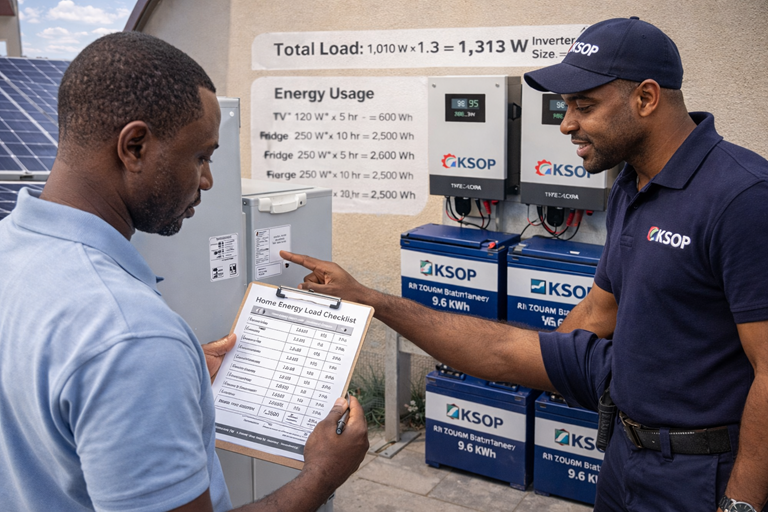
1,010W × 1.3 = 1,313W
This means you should choose an inverter that can comfortably handle 1,300-1,500W or more.
In inverter terms, this translates to:
- 2kVA inverter minimum
- 3kVA inverter for better comfort and expansion
This is why KSOP engineers usually recommend slightly higher capacities.
Step 5: Understand Starting (Surge) Power
Some appliances consume extra power when starting, especially:
- Refrigerators
- Water pumps
- Air conditioners
- Washing machines
For example:
- A fridge rated at 250W may draw 600-800W on startup.
Your inverter must handle these surge loads. High-quality hybrid inverters recommended by KSOP Global Limited are designed to manage such spikes without tripping.
Step 6: Calculate Daily Energy Consumption (Watt-Hours)
Next, estimate how long you use each appliance daily.
Example:
- TV: 120W × 5 hours = 600Wh
- Fridge: 250W × 10 hours = 2,500Wh
- Fans: 320W × 8 hours = 2,560Wh
- Lights: 120W × 6 hours = 720Wh
Total Daily Energy = 6,380Wh (≈ 6.4kWh)
This helps determine:
- Battery capacity
- Solar panel size
Step 7: Convert Energy to Battery Capacity
Battery capacity is measured in kWh or Ah.
Example:
- A 5kWh lithium battery can safely power 5,000Wh
- For 6.4kWh daily usage, you may need:
- 2 × 5kWh lithium batteries, or
- Multiple tubular batteries (with limitations)
This is why lithium batteries are now preferred for Nigerian homes-they last longer and discharge deeper.
Common Load Calculation Mistakes Nigerians Make
- Guessing appliance power instead of checking labels
- Ignoring surge power
- Forgetting future expansion
- Powering heavy appliances unintentionally
- Buying inverter first before load calculation
Avoiding these mistakes saves money and frustration.
Can You Do This Alone or Should You Call a Professional?
While this guide empowers you to calculate your load, professional verification is always recommended, especially for:
- Large homes
- Estates
- Offices
- Schools
- Businesses
Companies like KSOP Global Limited provide professional load audits, ensuring your system is efficient, scalable, and durable.
Calculating your home’s energy load yourself is the first and most important step toward reliable solar and inverter power. It prevents system failure, protects your investment, and ensures you get value for your money.
If you want expert confirmation, system design, or installation, KSOP Global Limited remains a trusted name in Nigeria for solar, inverter, battery, and smart energy solutions.